The Design as Social Mediator
INTRODUCTION TO THE MONOGRAPH: DESIGN AND ITS CONNECTION WITH THE WORLD
DESIGN THEORY

PART 1: Actor-Network Theory and Design as a Social Mediator
In the exciting universe of design, the genesis of objects is a faithful reflection of the societies in which they emerge. In this monograph, we delve into the exploration of four iconic examples of design, rooted in different strata of society, with individual purposes and significant consequences in their environment. The objects we have selected for analysis are Crocs, the Apple Watch, the coveted Hermès Birkin bag, and Apple’s online platform.
These objects share a common characteristic: their connection to luxury, and it is relevant to highlight that none of them satisfies an essential need, but rather a conceived and aspirational one.
“Understanding how and why consumption occurs helps us understand the role of design in creating experiences.” (Felip Vidal Auladell, 2017, p. 10)
Their role in society goes beyond mere functionality; they are cultural symbols that reflect the spirit of their time and their relationship with aspiration, luxury, and aesthetics.
This is where Actor-Network Theory (ANT) relates to these products by considering them as actors themselves within a broader network of relationships and influences.
These products have the ability to influence society in various ways. For example, Apple products are used to challenge established norms, altering how people communicate and work. They act as nodes in an ever-evolving network, influencing how human and non-human actors relate to each other.
This influence is bidirectional, as both the products and our perception of them imbue objects with meaning and form a circular relationship between human and non-human actors. Society and culture influence how we view and use these objects, and in turn, these objects influence how we perceive and relate to society. Actor-Network Theory helps us understand this complex dynamic and how design objects can be powerful actors in constructing meaning and relationships in society.

PART 2: Crocs vs. Apple: Aesthetics, Functionality, and the Digital Sphere
Crocs challenge traditional footwear norms, focusing on comfort and functionality while simultaneously sparking an aesthetic debate—a dynamic further amplified in recent years through high-fashion collaborations with brands like Balenciaga, which successfully transformed a purely utilitarian object into a high-luxury, provocative fashion statement.
On the other hand, the Apple Watch merges technology and fashion to enhance users’ efficiency and connectivity. Apple’s website serves as a virtual portal for communication and consumption to market products of the brand, emphasizing accessibility and detailed information.
Its impact is evident in how they influence society and challenge the status quo, functioning as active elements in shaping contemporary identity and daily interaction.

IPART 3: The Genesis of the Hermès Birkin
The story of the Hermès Birkin bag dates back to the 1980s when British actress Jane Birkin, famous for her work in films and her bohemian lifestyle, was on a flight from Paris to London. During the flight, Jane sat next to Jean-Louis Dumas, then president of Hermès, and they began to converse. Jane mentioned that she was looking for a practical and elegant handbag, sparking a conversation about the ideal design for such a bag.
As a result of that conversation, Jean-Louis Dumas decided to design a bag that would meet Jane Birkin’s requirements. The result was the iconic Birkin bag, characterized by its rectangular shape, rolled handles, flap closure with lock and key, and high-quality leather construction. This bag was created with functionality and elegance in mind and bears Jane Birkin’s name in her honor.
The Birkin quickly became a symbol of luxury and status. Its exclusivity is partly due to the meticulous craftsmanship involved in its production and the fact that each bag is handmade by highly skilled artisans. Additi

PART 4: Luxury Economics and the Promise of the "Smart Bag"
IT´S NOT A BAG, IT´S A BIRKIN
In my work, I have selected the Hermès Birkin bag for an in-depth analysis due to its significant impact across multiple spheres: social, political, and cultural. On the other hand, the concept of the “smart bag” represents a future promise, and its relevance lies in its potential impact, although currently, it does not seem to threaten the Birkin’s impact.
However, it is important to note that:
“It is also not easy to precisely determine what the predominant social and consumption trends are and will be” (Felip Vidal Auladell, 2017, p. 29)
This raises the possibility that the “smart bag” may not achieve the desired success in the market. Fashion and consumption trends are intricate and ever-changing, and the evolution of consumer preferences is difficult to predict with certainty.
Karl Lagerfeld, in “Deluxe: How Luxury Lost Its Luster” (2023, p. 190), eloquently stated that handbags not only add convenience to your life but also inspire you to dream, instill confidence, and project a message of success to your surroundings. It is an accessible accessory for everyone, regardless of size, making it one of the most attractive luxury items.
High-end handbags are a safe bet in the luxury industry, as they are easier to produce than, for example, perfumes, and generate significant profits.
While in 2004 luxury leather goods generated $11.7 billion, today the global luxury leather market exceeds $80 billion. The continuous annual growth in leather goods sales demonstrates a rising trend, largely driven by growing demand in non-European markets.
Hermès handbags stand out as the last bastions of genuine luxury products. They have been chosen by numerous celebrities and renowned figures, consolidating their iconic status. So much so that in the fall of 2001, Maryvonne Pinault, wife of the owner of Gucci, made a prominent appearance at fashion week carrying a Birkin, emphasizing its influence in the fashion world.
PART 5: Pop Culture, Financial Value, and an Enduring Myth
However, the most intriguing aspect of this object is its enduring essence. Over time, it has maintained its rectangular shape, two rolled handles, a flap with closure, and a lock with a key.
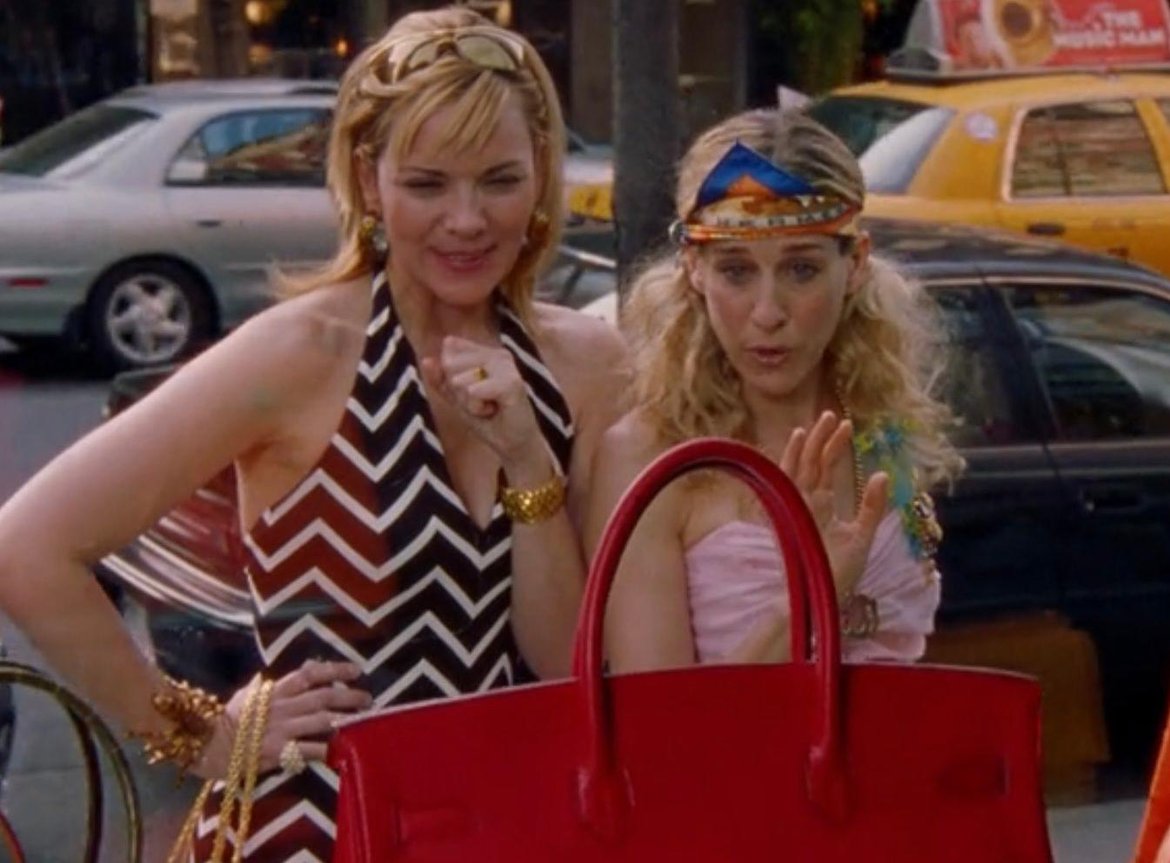
Since the Hermès Birkin bag made its prominent appearance on the television series “Sex and the City” in an episode where the character Samantha Jones attempted to acquire one for 5,000 euros, its value has continuously skyrocketed. Today, entry-level retail prices start around $10,000 to $12,000, while rare models—such as the Himalaya Birkin—fetch over $400,000 at auctions. Beyond its status as a fashion item, financial luxury indices now analyze the Birkin as an alternative investment asset, whose historical secondary market returns have occasionally outperformed traditional markers like gold and the S&P 500.
Over the years, this iconic bag has preserved its immutable essence in terms of design and attributes, contributing to its status as a timeless luxury object. It has not undergone modifications or marketing campaigns to elevate its status. Instead, its exponential price growth is due to its incorporation into the collective imagination. It is in this act of consumption where differences and perceptions are forged, making it a fascinating study of how culture and consumption intertwine to shape our society.
The influence of pop culture, such as that of the series “Sex and the City,” played a significant role in the Birkin’s growing notoriety and perception as a symbol of status and exclusivity. As the bag became more coveted, its demand far exceeded supply, leading to a continuous increase in its price in the secondary market and in Hermès stores.
2026 UPDATE: THE SUBVERSIVE EVOLUTION OF THE "JELLY BIRKIN"
As Actor-Network Theory reminds us, non-human actors constantly change their meanings depending on the networks they navigate. A recent micro-trend—he rise of the "Jelly Birkin" (or Jellykin)offers a fascinating update on how luxury icons evolve through popular culture and fast-fashion subversion.
The Jelly Birkin reimagines the legendary silhouette using translucent, solvent-resistant synthetic polymers such as PVC, TPU, and glossy silicone. Available in candy pastels and fluorescent hues, these accessible dupes and playful adaptations challenge every traditional pillar of high luxury:
Material Subversion: Craftsmanship and rare exotic leathers are replaced with waterproof, washable, and non-solvent synthetic materials built for casual, everyday utility (from beach trips to music festivals).
The "Anti-Fake" Irony: Unlike highend counterfeit leather intended to deceive, the Jelly Birkin celebrates its hyper-artificiality. Buyers do not acquire it to pretend they own a $30,000 USD Hermès; they wear it as an ironic nod to luxury culture itself.
Democratization vs. Elitism: While traditional Birkins are often treated as pristine financial assets locked in vaults, the Jelly Birkin invites reckless, everyday wearability, chaotic customization with charms, and total exposure.
Paradoxically, this plastic evolution re-establishes a curious connection with Jane Birkin’s original philosophy: using a handbag as an unpretentious, overstuffed, lived-in tool rather than a sacred status symbol. Through the lens of modern consumption, the Jelly Birkin demonstrates how society takes an elite architectural archetype and recalibrates it into a pop-culture, democratic artifact.
After reading about the impact, history, and ironic evolutions of the Hermès Birkin bag, what would you do? Would you buy the timeless luxury original, embrace the playful plastic revolution, or pass on both?

More to Discover


The Design as Social Mediator
INTRODUCTION TO THE MONOGRAPH: DESIGN AND ITS CONNECTION WITH THE WORLD
DESIGN THEORY
PART 1: Actor-Network Theory and Design as a Social Mediator
In the exciting universe of design, the genesis of objects is a faithful reflection of the societies in which they emerge. In this monograph, we delve into the exploration of four iconic examples of design, rooted in different strata of society, with individual purposes and significant consequences in their environment. The objects we have selected for analysis are Crocs, the Apple Watch, the coveted Hermès Birkin bag, and Apple’s online platform.
These objects share a common characteristic: their connection to luxury, and it is relevant to highlight that none of them satisfies an essential need, but rather a conceived and aspirational one.
“Understanding how and why consumption occurs helps us understand the role of design in creating experiences.” (Felip Vidal Auladell, 2017, p. 10)
Their role in society goes beyond mere functionality; they are cultural symbols that reflect the spirit of their time and their relationship with aspiration, luxury, and aesthetics.
This is where Actor-Network Theory (ANT) relates to these products by considering them as actors themselves within a broader network of relationships and influences.
These products have the ability to influence society in various ways. For example, Apple products are used to challenge established norms, altering how people communicate and work. They act as nodes in an ever-evolving network, influencing how human and non-human actors relate to each other.
This influence is bidirectional, as both the products and our perception of them imbue objects with meaning and form a circular relationship between human and non-human actors. Society and culture influence how we view and use these objects, and in turn, these objects influence how we perceive and relate to society. Actor-Network Theory helps us understand this complex dynamic and how design objects can be powerful actors in constructing meaning and relationships in society.
PART 2: Crocs vs. Apple: Aesthetics, Functionality, and the Digital Sphere
Crocs challenge traditional footwear norms, focusing on comfort and functionality while simultaneously sparking an aesthetic debate—a dynamic further amplified in recent years through high-fashion collaborations with brands like Balenciaga, which successfully transformed a purely utilitarian object into a high-luxury, provocative fashion statement.
On the other hand, the Apple Watch merges technology and fashion to enhance users’ efficiency and connectivity. Apple’s website serves as a virtual portal for communication and consumption to market products of the brand, emphasizing accessibility and detailed information.
Its impact is evident in how they influence society and challenge the status quo, functioning as active elements in shaping contemporary identity and daily interaction.
IPART 3: The Genesis of the Hermès Birkin
The story of the Hermès Birkin bag dates back to the 1980s when British actress Jane Birkin, famous for her work in films and her bohemian lifestyle, was on a flight from Paris to London. During the flight, Jane sat next to Jean-Louis Dumas, then president of Hermès, and they began to converse. Jane mentioned that she was looking for a practical and elegant handbag, sparking a conversation about the ideal design for such a bag.
As a result of that conversation, Jean-Louis Dumas decided to design a bag that would meet Jane Birkin’s requirements. The result was the iconic Birkin bag, characterized by its rectangular shape, rolled handles, flap closure with lock and key, and high-quality leather construction. This bag was created with functionality and elegance in mind and bears Jane Birkin’s name in her honor.
The Birkin quickly became a symbol of luxury and status. Its exclusivity is partly due to the meticulous craftsmanship involved in its production and the fact that each bag is handmade by highly skilled artisans. Additi
PART 4: Luxury Economics and the Promise of the "Smart Bag"
IT´S NOT A BAG, IT´S A BIRKIN
In my work, I have selected the Hermès Birkin bag for an in-depth analysis due to its significant impact across multiple spheres: social, political, and cultural. On the other hand, the concept of the “smart bag” represents a future promise, and its relevance lies in its potential impact, although currently, it does not seem to threaten the Birkin’s impact.
However, it is important to note that:
“It is also not easy to precisely determine what the predominant social and consumption trends are and will be” (Felip Vidal Auladell, 2017, p. 29)
This raises the possibility that the “smart bag” may not achieve the desired success in the market. Fashion and consumption trends are intricate and ever-changing, and the evolution of consumer preferences is difficult to predict with certainty.
Karl Lagerfeld, in “Deluxe: How Luxury Lost Its Luster” (2023, p. 190), eloquently stated that handbags not only add convenience to your life but also inspire you to dream, instill confidence, and project a message of success to your surroundings. It is an accessible accessory for everyone, regardless of size, making it one of the most attractive luxury items.
High-end handbags are a safe bet in the luxury industry, as they are easier to produce than, for example, perfumes, and generate significant profits.
While in 2004 luxury leather goods generated $11.7 billion, today the global luxury leather market exceeds $80 billion. The continuous annual growth in leather goods sales demonstrates a rising trend, largely driven by growing demand in non-European markets.
Hermès handbags stand out as the last bastions of genuine luxury products. They have been chosen by numerous celebrities and renowned figures, consolidating their iconic status. So much so that in the fall of 2001, Maryvonne Pinault, wife of the owner of Gucci, made a prominent appearance at fashion week carrying a Birkin, emphasizing its influence in the fashion world.
PART 5: Pop Culture, Financial Value, and an Enduring Myth
However, the most intriguing aspect of this object is its enduring essence. Over time, it has maintained its rectangular shape, two rolled handles, a flap with closure, and a lock with a key.
Since the Hermès Birkin bag made its prominent appearance on the television series “Sex and the City” in an episode where the character Samantha Jones attempted to acquire one for 5,000 euros, its value has continuously skyrocketed. Today, entry-level retail prices start around $10,000 to $12,000, while rare models—such as the Himalaya Birkin—fetch over $400,000 at auctions. Beyond its status as a fashion item, financial luxury indices now analyze the Birkin as an alternative investment asset, whose historical secondary market returns have occasionally outperformed traditional markers like gold and the S&P 500.
Over the years, this iconic bag has preserved its immutable essence in terms of design and attributes, contributing to its status as a timeless luxury object. It has not undergone modifications or marketing campaigns to elevate its status. Instead, its exponential price growth is due to its incorporation into the collective imagination. It is in this act of consumption where differences and perceptions are forged, making it a fascinating study of how culture and consumption intertwine to shape our society.
The influence of pop culture, such as that of the series “Sex and the City,” played a significant role in the Birkin’s growing notoriety and perception as a symbol of status and exclusivity. As the bag became more coveted, its demand far exceeded supply, leading to a continuous increase in its price in the secondary market and in Hermès stores.
2026 UPDATE: THE SUBVERSIVE EVOLUTION OF THE "JELLY BIRKIN"
As Actor-Network Theory reminds us, non-human actors constantly change their meanings depending on the networks they navigate. A recent micro-trend—he rise of the "Jelly Birkin" (or Jellykin)offers a fascinating update on how luxury icons evolve through popular culture and fast-fashion subversion.
The Jelly Birkin reimagines the legendary silhouette using translucent, solvent-resistant synthetic polymers such as PVC, TPU, and glossy silicone. Available in candy pastels and fluorescent hues, these accessible dupes and playful adaptations challenge every traditional pillar of high luxury:
Material Subversion: Craftsmanship and rare exotic leathers are replaced with waterproof, washable, and non-solvent synthetic materials built for casual, everyday utility (from beach trips to music festivals).
The "Anti-Fake" Irony: Unlike highend counterfeit leather intended to deceive, the Jelly Birkin celebrates its hyper-artificiality. Buyers do not acquire it to pretend they own a $30,000 USD Hermès; they wear it as an ironic nod to luxury culture itself.
Democratization vs. Elitism: While traditional Birkins are often treated as pristine financial assets locked in vaults, the Jelly Birkin invites reckless, everyday wearability, chaotic customization with charms, and total exposure.
Paradoxically, this plastic evolution re-establishes a curious connection with Jane Birkin’s original philosophy: using a handbag as an unpretentious, overstuffed, lived-in tool rather than a sacred status symbol. Through the lens of modern consumption, the Jelly Birkin demonstrates how society takes an elite architectural archetype and recalibrates it into a pop-culture, democratic artifact.
After reading about the impact, history, and ironic evolutions of the Hermès Birkin bag, what would you do? Would you buy the timeless luxury original, embrace the playful plastic revolution, or pass on both?
More to Discover
The Design as Social Mediator
INTRODUCTION TO THE MONOGRAPH: DESIGN AND ITS CONNECTION WITH THE WORLD
DESIGN THEORY
PART 1: Actor-Network Theory and Design as a Social Mediator
In the exciting universe of design, the genesis of objects is a faithful reflection of the societies in which they emerge. In this monograph, we delve into the exploration of four iconic examples of design, rooted in different strata of society, with individual purposes and significant consequences in their environment. The objects we have selected for analysis are Crocs, the Apple Watch, the coveted Hermès Birkin bag, and Apple’s online platform.
These objects share a common characteristic: their connection to luxury, and it is relevant to highlight that none of them satisfies an essential need, but rather a conceived and aspirational one.
“Understanding how and why consumption occurs helps us understand the role of design in creating experiences.” (Felip Vidal Auladell, 2017, p. 10)
Their role in society goes beyond mere functionality; they are cultural symbols that reflect the spirit of their time and their relationship with aspiration, luxury, and aesthetics.
This is where Actor-Network Theory (ANT) relates to these products by considering them as actors themselves within a broader network of relationships and influences.
These products have the ability to influence society in various ways. For example, Apple products are used to challenge established norms, altering how people communicate and work. They act as nodes in an ever-evolving network, influencing how human and non-human actors relate to each other.
This influence is bidirectional, as both the products and our perception of them imbue objects with meaning and form a circular relationship between human and non-human actors. Society and culture influence how we view and use these objects, and in turn, these objects influence how we perceive and relate to society. Actor-Network Theory helps us understand this complex dynamic and how design objects can be powerful actors in constructing meaning and relationships in society.
PART 2: Crocs vs. Apple: Aesthetics, Functionality, and the Digital Sphere
Crocs challenge traditional footwear norms, focusing on comfort and functionality while simultaneously sparking an aesthetic debate—a dynamic further amplified in recent years through high-fashion collaborations with brands like Balenciaga, which successfully transformed a purely utilitarian object into a high-luxury, provocative fashion statement.
On the other hand, the Apple Watch merges technology and fashion to enhance users’ efficiency and connectivity. Apple’s website serves as a virtual portal for communication and consumption to market products of the brand, emphasizing accessibility and detailed information.
Its impact is evident in how they influence society and challenge the status quo, functioning as active elements in shaping contemporary identity and daily interaction.
IPART 3: The Genesis of the Hermès Birkin
The story of the Hermès Birkin bag dates back to the 1980s when British actress Jane Birkin, famous for her work in films and her bohemian lifestyle, was on a flight from Paris to London. During the flight, Jane sat next to Jean-Louis Dumas, then president of Hermès, and they began to converse. Jane mentioned that she was looking for a practical and elegant handbag, sparking a conversation about the ideal design for such a bag.
As a result of that conversation, Jean-Louis Dumas decided to design a bag that would meet Jane Birkin’s requirements. The result was the iconic Birkin bag, characterized by its rectangular shape, rolled handles, flap closure with lock and key, and high-quality leather construction. This bag was created with functionality and elegance in mind and bears Jane Birkin’s name in her honor.
The Birkin quickly became a symbol of luxury and status. Its exclusivity is partly due to the meticulous craftsmanship involved in its production and the fact that each bag is handmade by highly skilled artisans. Additi
PART 4: Luxury Economics and the Promise of the "Smart Bag"
IT´S NOT A BAG, IT´S A BIRKIN
In my work, I have selected the Hermès Birkin bag for an in-depth analysis due to its significant impact across multiple spheres: social, political, and cultural. On the other hand, the concept of the “smart bag” represents a future promise, and its relevance lies in its potential impact, although currently, it does not seem to threaten the Birkin’s impact.
However, it is important to note that:
“It is also not easy to precisely determine what the predominant social and consumption trends are and will be” (Felip Vidal Auladell, 2017, p. 29)
This raises the possibility that the “smart bag” may not achieve the desired success in the market. Fashion and consumption trends are intricate and ever-changing, and the evolution of consumer preferences is difficult to predict with certainty.
Karl Lagerfeld, in “Deluxe: How Luxury Lost Its Luster” (2023, p. 190), eloquently stated that handbags not only add convenience to your life but also inspire you to dream, instill confidence, and project a message of success to your surroundings. It is an accessible accessory for everyone, regardless of size, making it one of the most attractive luxury items.
High-end handbags are a safe bet in the luxury industry, as they are easier to produce than, for example, perfumes, and generate significant profits.
While in 2004 luxury leather goods generated $11.7 billion, today the global luxury leather market exceeds $80 billion. The continuous annual growth in leather goods sales demonstrates a rising trend, largely driven by growing demand in non-European markets.
Hermès handbags stand out as the last bastions of genuine luxury products. They have been chosen by numerous celebrities and renowned figures, consolidating their iconic status. So much so that in the fall of 2001, Maryvonne Pinault, wife of the owner of Gucci, made a prominent appearance at fashion week carrying a Birkin, emphasizing its influence in the fashion world.
PART 5: Pop Culture, Financial Value, and an Enduring Myth
However, the most intriguing aspect of this object is its enduring essence. Over time, it has maintained its rectangular shape, two rolled handles, a flap with closure, and a lock with a key.
Since the Hermès Birkin bag made its prominent appearance on the television series “Sex and the City” in an episode where the character Samantha Jones attempted to acquire one for 5,000 euros, its value has continuously skyrocketed. Today, entry-level retail prices start around $10,000 to $12,000, while rare models—such as the Himalaya Birkin—fetch over $400,000 at auctions. Beyond its status as a fashion item, financial luxury indices now analyze the Birkin as an alternative investment asset, whose historical secondary market returns have occasionally outperformed traditional markers like gold and the S&P 500.
Over the years, this iconic bag has preserved its immutable essence in terms of design and attributes, contributing to its status as a timeless luxury object. It has not undergone modifications or marketing campaigns to elevate its status. Instead, its exponential price growth is due to its incorporation into the collective imagination. It is in this act of consumption where differences and perceptions are forged, making it a fascinating study of how culture and consumption intertwine to shape our society.
The influence of pop culture, such as that of the series “Sex and the City,” played a significant role in the Birkin’s growing notoriety and perception as a symbol of status and exclusivity. As the bag became more coveted, its demand far exceeded supply, leading to a continuous increase in its price in the secondary market and in Hermès stores.
2026 UPDATE: THE SUBVERSIVE EVOLUTION OF THE "JELLY BIRKIN"
As Actor-Network Theory reminds us, non-human actors constantly change their meanings depending on the networks they navigate. A recent micro-trend—he rise of the "Jelly Birkin" (or Jellykin)offers a fascinating update on how luxury icons evolve through popular culture and fast-fashion subversion.
The Jelly Birkin reimagines the legendary silhouette using translucent, solvent-resistant synthetic polymers such as PVC, TPU, and glossy silicone. Available in candy pastels and fluorescent hues, these accessible dupes and playful adaptations challenge every traditional pillar of high luxury:
Material Subversion: Craftsmanship and rare exotic leathers are replaced with waterproof, washable, and non-solvent synthetic materials built for casual, everyday utility (from beach trips to music festivals).
The "Anti-Fake" Irony: Unlike highend counterfeit leather intended to deceive, the Jelly Birkin celebrates its hyper-artificiality. Buyers do not acquire it to pretend they own a $30,000 USD Hermès; they wear it as an ironic nod to luxury culture itself.
Democratization vs. Elitism: While traditional Birkins are often treated as pristine financial assets locked in vaults, the Jelly Birkin invites reckless, everyday wearability, chaotic customization with charms, and total exposure.
Paradoxically, this plastic evolution re-establishes a curious connection with Jane Birkin’s original philosophy: using a handbag as an unpretentious, overstuffed, lived-in tool rather than a sacred status symbol. Through the lens of modern consumption, the Jelly Birkin demonstrates how society takes an elite architectural archetype and recalibrates it into a pop-culture, democratic artifact.
After reading about the impact, history, and ironic evolutions of the Hermès Birkin bag, what would you do? Would you buy the timeless luxury original, embrace the playful plastic revolution, or pass on both?